Currently accepting same-day emergency patients across Louisville, KY. Average callback time is under 12 minutes.
Dental Bridges in Louisville, KY | Fixed Missing Tooth Replacement
Fixed Bridges That Fill the Gap for Good
Emergency Dentists Louisville offers dental bridges for the entire Louisville area. A bridge does exactly what its name suggests: it spans the gap left by one or more missing teeth with natural-looking replacement teeth, anchored securely so you can chew, speak, and smile like the gap never happened.
Bridges are fixed in place, shade-matched to your smile, and finished in a few weeks, and according to the ADA, the average adult has around three missing or decayed teeth, so if you're here, you're in good company and in the right place.
Tell us what's going on. We'll call you back fast.
We'll respond same-day. If you need to be seen right now, call us directly at 502-793-2102.
Our Custom Dental Bridge and Gap Restoration Services
Our dental bridges in Louisville, KY replace one or more missing teeth using the neighboring teeth as anchors, helping restore chewing function and stopping those adjacent teeth drifting into the space and changing the way your teeth meet. We are the Louisville practice that compares a bridge honestly against an implant or partial denture before recommending anything, weighing your bone level, your timeline and your budget.
How a Dental Bridge Works
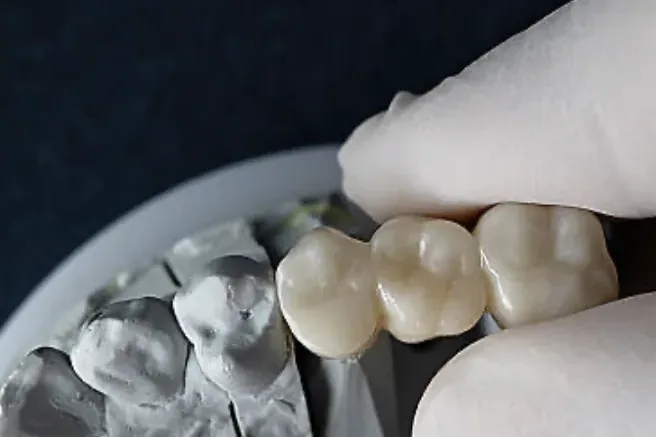
A bridge has two working parts. The anchors, called abutments, are crowns placed on the supporting teeth on either side of the gap (or on dental implants). The replacement tooth, called a pontic, is fused between those crowns, filling the space with a tooth that looks and functions like the real thing. Once cemented, the whole assembly is fixed in place: no removing it at night, no adhesives, and to anyone looking, virtually imperceptible.
Filling the gap matters for far more than appearance. Left open, the neighboring teeth drift and tilt into the space, the opposing tooth over-erupts, and your bite slowly goes crooked, which makes teeth harder to clean and raises your risk of decay and gum disease. A missing back tooth also shifts chewing load onto other teeth and can let your cheek and lips lose support, aging the look of your face. Replacing an appropriate missing tooth can help maintain function, reduce unwanted tooth movement, and restore the appearance of the smile: it holds every tooth in its lane, restores full chewing and clear speech, and keeps small problems from compounding into expensive ones.
The Four Types of Dental Bridges
Traditional BridgeThe most common type: crowns on the teeth either side of the gap support the pontic between them. Strong, proven, and usually made from porcelain fused to metal or all-ceramic materials.
Implant-Supported BridgeDental implants replace the anchors instead of natural teeth. The most secure option, ideal when several adjacent teeth are missing or when you'd rather not crown healthy neighbors.
Cantilever BridgeAnchored on one side only, used when healthy teeth exist on just one side of the gap. Placement matters: the lever effect adds stress to the anchor tooth, so we use these selectively and rarely in heavy-chewing back areas.
Maryland (Resin-Bonded) BridgeWings bonded to the backs of neighboring teeth hold the pontic, preserving those teeth by skipping full crowns. The trade-off is less strength under heavy biting, which makes it best suited to front teeth.
Which type fits you depends on where the gap is, the condition of the neighboring teeth, and your bite. That's exactly what the consultation determines, with X-rays and straight talk rather than a one-size answer.
Should I Get a Bridge or an Implant?
This is the question behind most bridge consultations, and the honest answer is: it depends, and both are good answers. An implant replaces the tooth root itself, preserves jawbone, and doesn't touch the neighboring teeth, which makes it the a strong long-term option when your bone and health support it. A bridge wins in several common situations: when there isn't enough jawbone for an implant and you'd rather skip grafting surgery, when the neighboring teeth already need crowns anyway (so the bridge does double duty), when you want a fixed result in weeks instead of the months an implant takes to heal, and when budget is the deciding factor today.
What we won't do is push you toward either one by default. At your consultation we'll assess your bone, your neighboring teeth, and your priorities, then lay out both options with real prices side by side. Our replacing missing teeth page compares the full menu if you want the complete picture before you come in. Either way, the Whether a missing tooth needs replacement depends on its location, your bite, surrounding teeth, bone support, and your treatment goals, and both of these beat it decisively.
Getting Your Bridge, Visit by Visit
1. Exam and Preparation
After X-rays confirm the neighboring teeth are healthy anchors, we numb the area and shape the abutment teeth so their crowns will fit flush and natural. Digital impressions capture your bite precisely, because the bridge must meet your opposing teeth exactly. Our dental crowns page explains the crown side of this work in detail.
2. Your Temporary Bridge
You leave the first visit with a temporary bridge protecting the prepared teeth and filling the gap, so you're never walking around with an open space while the lab custom-crafts your permanent bridge, typically over about two weeks.
3. Fitting and Cementing
At the second visit we remove the temporary, try in your permanent bridge, and fine-tune the fit, bite, and shade until everything is exactly right. Porcelain is matched to your natural tooth color, so the finished bridge disappears into your smile. Once you and we are both satisfied, it's cemented permanently, and we'll check it at your routine visits from then on.
Lifespan, Care, and Cost
With good care, bridges routinely last 10 to 15 years, and many make it to 20. The one of the most important habits for protecting a bridge is cleaning carefully underneath the pontic and around the abutment teeth is cleaning under it: the pontic sits on your gums, and food and plaque collecting beneath it threaten the anchor teeth the whole structure depends on. We'll show you the two-minute technique with floss threaders or a water flosser, and beyond that, care is ordinary: brush twice daily, go easy on very sticky and chewy foods, and keep your regular checkups so we can monitor the anchors.
Cost scales with the number of pontics and the type of bridge, and most dental insurance plans cover bridges as major restorative care, typically around 50 percent. We verify your benefits, price the implant alternative alongside it, and put everything in writing before any tooth is touched, and Financing options available can spread the remainder into monthly payments.
Why Choose Emergency Dentists Louisville
All four bridge types, recommended by what your mouth needs rather than what's easiest to sell.
Digital impressions and shade matching for a bridge that blends invisibly into your smile.
Honest bridge-vs-implant comparisons with both prices in writing before you decide.
Never left with a gap: a temporary bridge protects your smile from day one.
Typically two visits over two to three weeks: preparation and impressions at the first, fitting and cementing at the second. You wear a natural-looking temporary bridge in between, so you're never left with a visible gap.
Does getting a bridge hurt?
No, the area is fully numbed during preparation, so you feel pressure rather than pain. Mild sensitivity in the anchor teeth for a few days afterward is normal and fades on its own.
How long do dental bridges last?
Most bridges last 10 to 15 years, and well-maintained ones can reach 20. Daily cleaning under the pontic and routine checkups on the anchor teeth are what get you to the high end.
Will my bridge look natural?
Yes, the porcelain is shade-matched to your surrounding teeth and the bridge is shaped to your bite, so the finished result is designed to closely match the color and shape of your surrounding teeth from natural teeth. On front teeth especially, invisibility is the whole design goal.
Does insurance cover dental bridges?
Most dental plans cover bridges as major restorative care, commonly around 50 percent after your deductible. We verify your exact benefits and give you a written estimate, alongside the implant comparison, before treatment begins.
Close the Gap and Get Your Bite Back
Two visits, a few weeks, and the gap can be restored with a fixed replacement that looks and functions much like a natural tooth. Start with a consultation and real numbers.